Program Notes
Gerard Manley Hopkin’s love for nature and its myriad shades of detail permeates most of his poetry. His sense of companionship with trees, weeds, light, water, and the like imbues his tightly constructed lines with a vibrance and energy that are uniquely sublime.
In Binsey Poplars, this genuine love for natural things is met with raw lamentation when he discovers that a grove of his dear aspen trees has been cut down. Throughout the poem, Hopkins wistfully reminisces about the beauty of the trees themselves but also the way they interacted with the scene; how their “airy cages quelled” the “leaping sun” and “dandled” the “shadow that swam or sank on meadow and river.” He also expresses anger at man’s selfish greed for nature’s resources; “O if we but knew what we do when we delve or hew—hack and rack the growing green!” Later, he makes a powerful and poignant analogy that nature and the globe itself are vulnerable to attack; “that, like this sleek and seeing ball but a prick will make no eye at all.” And perhaps saddest of all, Hopkins observes that the “sweet especial rural scene,” while still visible in his mind’s eye, is unknowable to those who never experienced the scene in its original, natural state; “after-comers cannot guess the beauty been.”
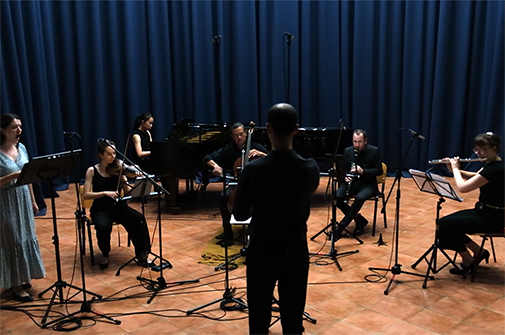
I’ve tried to capture the sense of Hopkin’s wistful memories, tinged with sadness, as well as his fierce outrage. The singer leads, acting as the voice of Hopkins himself, while the instruments flesh out the colors and textures of the fluctuating moods and shifting scenes. In brief, the music is meant to be as straightforward and emotionally honest as the poem itself.